The way people order food has changed for good. Diners now expect to browse a menu, customize their order, and pay for it in under two minutes — without calling anyone or waiting on hold. For restaurant owners, that shift makes one thing clear: an online ordering system isn’t optional anymore, it’s core infrastructure.
At Forgemetrix, we build ordering systems that help restaurants grow revenue while cutting down on the chaos of manual order-taking. Here’s everything you need to know about why online ordering matters, what a good system should do, and how to choose the right one for your restaurant.
What Is an Online Ordering System?
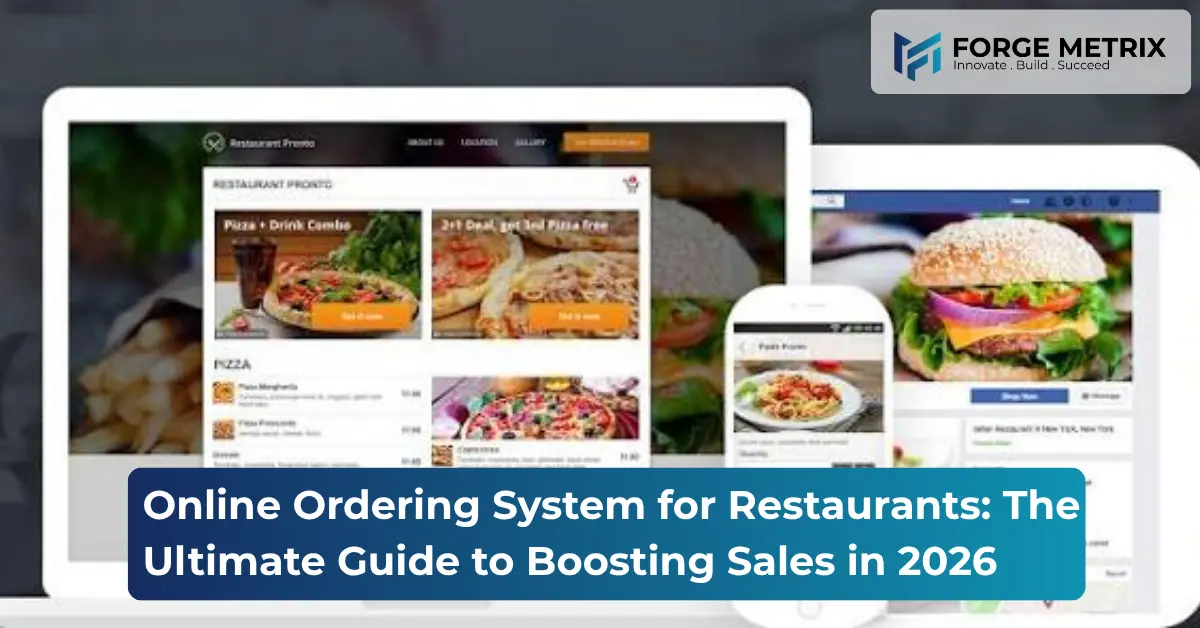
An online ordering system is software that lets customers view a restaurant’s menu, place an order, and pay — all from a website, mobile app, or QR code — without speaking to staff. Orders flow directly into the kitchen or point-of-sale (POS) system, cutting out the delays and errors that come with phone orders or third-party marketplace apps.
A modern system typically covers three types of ordering:
- Delivery — orders sent to the customer’s address
- Pickup — orders prepared for customer collection
- Dine-in / table ordering — orders placed via QR code at the table
Why Restaurants Need an Online Ordering System
1. Higher Average Order Value
Customers ordering online tend to spend more than those ordering by phone. Digital menus make upselling easy — combo suggestions, add-ons, and “frequently ordered together” prompts all nudge customers toward larger orders without any pressure from staff.
2. Fewer Errors, Fewer Refunds
Mishearing an order over a noisy phone line is one of the most common (and costly) mistakes in a restaurant. A digital order goes straight from the customer’s screen to the kitchen printer or KDS (kitchen display system) exactly as typed — no translation errors, no back-and-forth.
3. Lower Dependency on Third-Party Marketplaces
Third-party delivery marketplaces are convenient for reach, but they’re expensive. Most charge somewhere in the range of 15–30% commission per order, and once payment processing, promotions, and refunds are factored in, restaurants’ real effective cost is often closer to 30–40% of the order total (Rezku, 2026). A branded online ordering system on your own website lets you take direct orders and keep far more of every sale.
4. Better Customer Data — and Ownership of the Relationship
Every order placed through a third-party app builds a customer profile the platform owns — not you. You typically can’t see the customer’s name, email, or order history, which means no retargeting, no loyalty program, and no way to win them back directly (OPA!, 2026). Orders placed directly through your own website give you first-party data you can actually use — for loyalty programs, retargeting, and smarter menu decisions.
5. 24/7 Order Capacity
An online system doesn’t get busy signals, doesn’t need breaks, and doesn’t lose orders during a dinner rush. Customers can order whenever it’s convenient for them, and the system queues everything accurately.
Key Features to Look For in an Online Ordering System
Seamless Menu Management
You should be able to update prices, mark items sold out, add seasonal specials, and manage modifiers (like toppings or spice levels) in real time — without needing a developer.
POS and Kitchen Integration
The best systems sync directly with your existing POS and kitchen display system, so orders appear instantly without staff needing to manually re-key anything.
Mobile-First Design
Most online orders now come from phones. A system that isn’t fast and easy to use on mobile will lose customers at checkout.
Multiple Payment Options
Support for cards, digital wallets (Apple Pay, Google Pay), and even buy-now-pay-later options reduces friction and cart abandonment.
Order Tracking and Notifications
Customers want to know their order status. Automated SMS or email updates — “order confirmed,” “out for delivery,” “ready for pickup” — reduce support calls and improve the overall experience.
Loyalty and Marketing Tools
Built-in loyalty points, discount codes, and email/SMS marketing integrations turn one-time orders into repeat customers.
Analytics and Reporting
Look for dashboards that show best-selling items, peak order times, average order value, and customer retention — insights that help you make smarter operational decisions.
How to Choose the Right Online Ordering System
- Check integration compatibility — Make sure the system connects cleanly with your existing POS, kitchen equipment, and accounting tools.
- Compare commission structures — Some providers charge per-order fees, others charge flat monthly rates. Calculate which is cheaper at your order volume, keeping in mind that pickup orders typically carry far lower commission rates than delivery (Delivery App Fees Statistics, 2026).
- Test the customer experience yourself — Place a test order. If it’s confusing or slow for you, it will be for your customers too.
- Look for scalability — Choose a system that can grow with you, whether that means adding locations, delivery zones, or catering orders.
- Prioritize support — Downtime during a dinner rush can cost real money. Choose a provider with responsive, reliable support.
Final Thoughts
An online ordering system is no longer just a convenience — it’s a growth engine for restaurants. It reduces errors, increases order value, builds customer loyalty, and frees up staff to focus on food and service instead of taking orders over the phone. It’s also a hedge against rising third-party commission costs that are only getting harder for independent restaurants to absorb.
At Forgemetrix, we design and build custom online ordering systems tailored to how your restaurant actually operates — from menu structure to kitchen workflow to customer experience. If you’re ready to modernize how your restaurant takes orders, get in touch with our team to see how we can help.